Insight
How long will GENIUS Act applications really take?

How long will a GENIUS Act application really take? If you just look at the law's timelines and make some reasonable assumptions, you can be forgiven for estimating "somewhere between 120-180 days."
If you've been in the bank reg world for a while, you know the real answer is "you will never know ahead of time." Why? Meet "substantially complete."
The GENIUS Act requires primary federal regulators to "render a decision on the application" within 120 days of receiving a "substantially complete application," or the application is deemed approved.
This four-month timeline may appear short compared to typical bank charter applications, which often extend 12-18 months or longer. That's because the qualifier "substantially complete" fundamentally alters the impact of the statutory timelines.
The idea that an application must be "substantially complete" to start the clock is borrowed from other bank licensing frameworks. Experience from those frameworks shows that the condition makes approval timelines effectively indeterminate from the applicant's perspective.
The GENIUS Act tries to prevent indefinite post-filing delays by requiring regulators to notify applicants of deficiencies within 30 days and report to Congress on applications that remain incomplete more than 180 days since initial filing.
Yet similar mechanisms in other frameworks fail to make the timeframe predictable for the applicant. Regulators care subjectively about the timelines (and about reporting to Congress), but the applicant still experiences the process as subject to total regulatory discretion.
The agencies have multiple ways to manage both the timelines and the Congressional report. For example, as the 180-day threshold approaches, applicants may get "suggestions" to withdraw and resubmit applications, resetting the clock.
In addition, nothing prevents regulators from "offering" to engage in extensive pre-filing discussions and draft reviews. In bank chartering, these reviews can extend months before formal filing. While draft review is optional, even aggressive applicants find it hard to resist an offer for private review of a draft before the public formal submission.
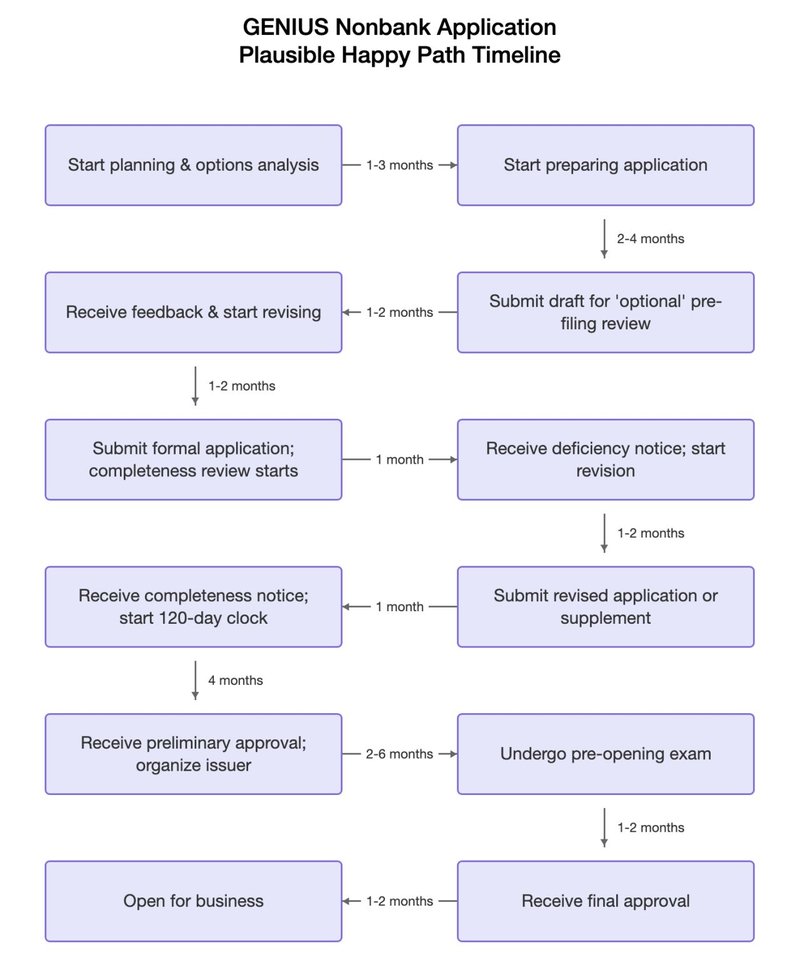
Regulators may have little choice but to use such methods when faced with the rush of applications and their own diminished resources. (Though a recent OCC reorg seems aimed at improving capacity to handle the surge of GENIUS-related work.)
But workload is only part of the story. There's a lot to consider in deciding a charter application. Most applicants leave something out, and many also misunderstand the follow-up questions. Both problems are likely to be exacerbated in a context where everyone is doing it for the first time.
The practical result is that, while the GENIUS Act's 120-day decision timeline may influence regulatory behavior at the margins, realistic approval timelines for complex issuer applications will likely be much longer than the statutory deadline suggests.